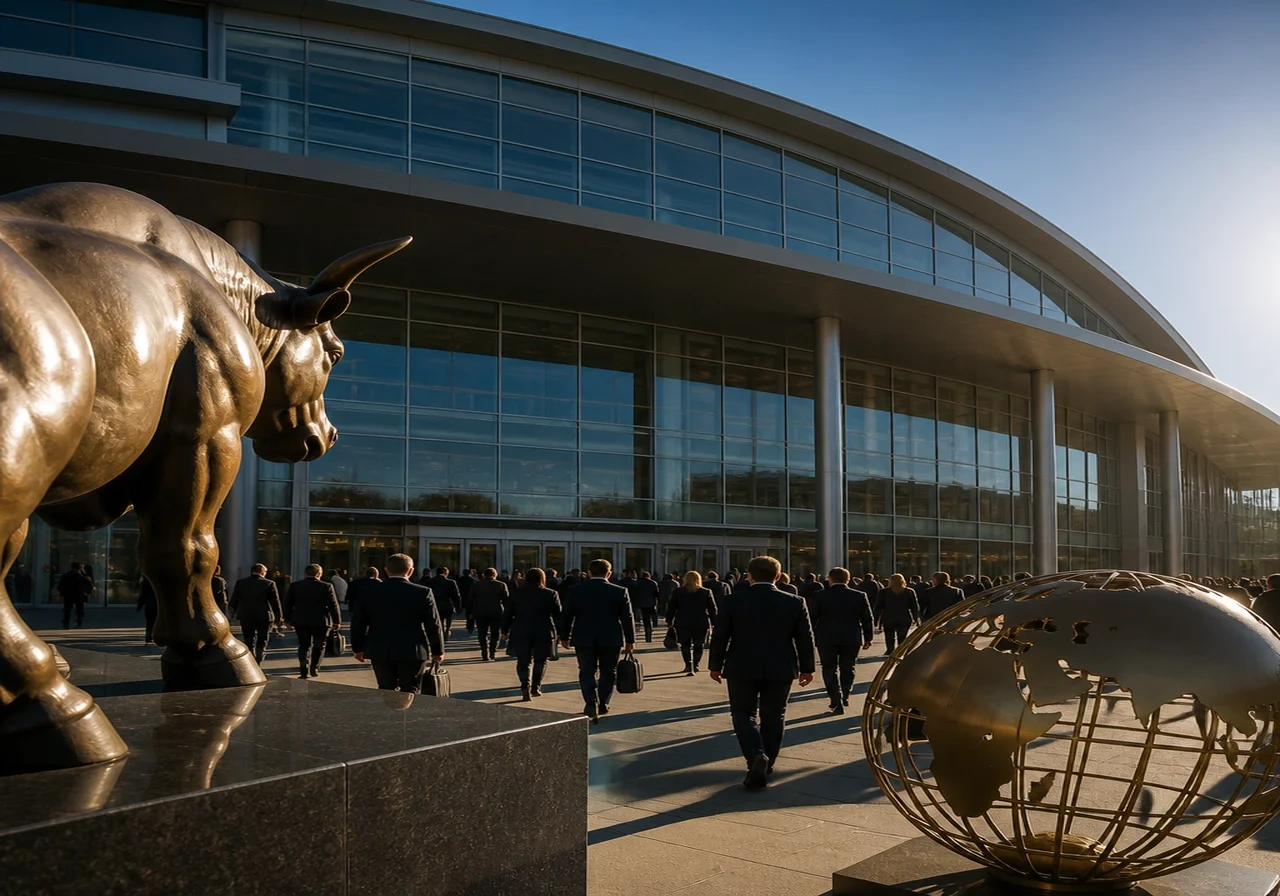
The 2026 Berkshire Hathaway Annual Meeting: A New Chapter
Every spring, tens of thousands of shareholders descend on Omaha, Nebraska, for what has long been called “Woodstock for Capitalists.” The 2026 edition of the Berkshire Hathaway Annual Meeting carried extra weight — it was the first since Warren Buffett stepped down as chief executive, handing the operating reins to Greg Abel. Buffett, now Chairman Emeritus, still joined the Q&A session, but the spotlight now belongs to the next generation.
The Warren Buffett shareholder meeting drew a packed CHI Health Center arena, and while the tone was celebratory, the discussions were substantive. Investors came looking for clarity on a record cash pile, a reshaped portfolio, and the new leader’s plans. The answers revealed a conglomerate that remains firmly committed to long‑term value, even as it makes some of the most decisive moves in its history.
Berkshire Hathaway 2026 Meeting: Cash Reserves and the OxyChem Acquisition
At the end of the second quarter of 2024, Berkshire’s cash reserves ballooned to an unprecedented $276.9 billion. That hoard went largely unspent through late 2024 and 2025, prompting many to wonder whether the new leadership would act differently. At the BRK annual meeting in early 2026, Greg Abel acknowledged the patience required but stressed that the culture of only swinging at fat pitches endures.
The first major swing under his watch came in January 2026, when Berkshire closed the acquisition of OxyChem from Occidental Petroleum for $9.7 billion in cash. The deal vaulted chemicals into a prominent spot within Berkshire’s industrial portfolio and showcased Abel’s deep familiarity with the energy and infrastructure sectors. As detailed in the data visualization below, the purchase ranks among the largest in the conglomerate’s recent history, trailing only the $11.6 billion Alleghany insurance takeover in 2022.
The accompanying table of major acquisitions from 2017 through 2026 illustrates how the firm has increasingly leaned toward large, cash‑intensive deals. The OxyChem purchase alone accounts for nearly one‑third of the capital deployed in the decade’s ten largest transactions. This pattern reinforces the narrative that Berkshire is not simply hoarding cash but waiting for assets that fit its long‑term circle of competence.
“Our cash is not a trophy. It’s ammunition for lasting value.”
Buffett Annual Meeting 2026: A Portfolio Overhaul
While the firm added OxyChem, the year’s more striking story lay in what it removed. By March 31, 2026, Berkshire had exited 16 positions entirely, including Visa, Mastercard, Amazon, and UnitedHealth Group. As we explored in our coverage of the Nubank stake sale, the exits from high‑multiple fintech names aren’t isolated. The broader portfolio is being rebalanced toward ideas with lower price‑to‑earnings ratios and more predictable cash flows.
The reasoning became plain at the Buffett annual meeting 2026. At the time of the reshuffle, Visa and Mastercard were trading at roughly 25.1 and 25.4 times projected earnings, while Bank of America – which Berkshire retained – traded at just 11.6 times estimated earnings and offered a 2.1% dividend yield. That value gap helps explain why the big bank remained a top‑five holding, accounting for 8% of the publicly traded stock portfolio.
The pruning didn’t spare Apple, either. In 2024, Berkshire sold roughly $75.5 billion worth of its Apple position, though the tech giant remains a core holding because Buffett and Abel view it as a consumer‑products franchise with an economic moat. The actions underscore a consistent thread: when valuations stretch beyond what the underlying business can justify over a decade, the firm gets uncomfortable and reallocates.
Meanwhile, the broader market is buzzing over Alphabet’s plan to raise $80 billion to fund AI infrastructure, a move that reportedly involves Berkshire as a participant. As we noted in our analysis of that massive offering, such a deployment would be a fitting use of the company’s cash reserves — a large‑scale, moat‑deepening investment that complements existing holdings in technology and finance. Whether this becomes a formal stake remains to be seen, but it highlights how Berkshire’s firepower can shape global capital flows.
Greg Abel’s Vision: Continuity with a Forward Look
Change at the top rarely comes without anxiety, but Abel worked to reassure shareholders. At the BRK annual meeting, he echoed the philosophy that made Buffett famous: “Buy wonderful businesses at fair prices and never become dependent on the kindness of strangers.” He stressed that Berkshire’s decentralized structure — where subsidiary managers run their operations with near‑total autonomy — will remain intact.
Abel’s deep operational background sets him apart. He spent years running Berkshire Hathaway Energy, which gave him hands‑on experience with regulated utilities, pipelines, and heavy infrastructure. The OxyChem deal reflects that comfort zone. He sees chemicals, energy, and insurance not as cyclical commodity plays but as essential industries where scale and financial strength create a lasting advantage.
The meeting also clarified succession at the investment level. While Abel will steer capital allocation, Todd Combs and Ted Weschler continue managing significant equity portfolios. Their influence is felt in the nimble shifts between financial and tech names, but the overriding mandate remains the same: invest only when the odds are overwhelmingly favorable.
Global Bets: Japan and the International Portfolio
One of the quieter triumphs at this Warren Buffett shareholder meeting was the performance of Berkshire’s stakes in five Japanese trading houses — Itochu, Marubeni, Mitsubishi, Mitsui, and Sumitomo. Originally disclosed in 2020, these holdings have delivered strong returns, boosted by dividend increases and share buybacks. Abel noted that the investments are now viewed as “permanent” positions, mirroring the treatment historically given to Coca-Cola and American Express.
The Japanese exposure provides diversification far beyond the U.S. dollar, a benefit that has become more valuable as trade tensions and geopolitical uncertainty simmer. While some attendees questioned the logic of keeping ties to companies that deal in everything from noodles to jet fuel, Abel argued that the trading houses’ broad footprint mirrors Berkshire’s own conglomerate model — a portfolio of essential businesses that benefit from global growth without being overly reliant on any single region or sector.
The international chapter also includes the recent exit from Nu Holdings, the Brazilian fintech backed early by Berkshire. The $500 million initial investment in 2021, made when the bank was still expanding across Latin America, was fully liquidated by early 2026 — another move that aligns with the overall pivot toward lower‑valuation, higher‑moat names.
Conclusion
The 2026 meeting marked the end of an era but also revealed how deeply the Buffett playbook has been woven into the organization’s DNA. The cash pile remains record‑breaking, yet the disciplined deployment in OxyChem shows no appetite for wasteful spending. The portfolio pruning — from Nu to Visa — signals a rigorous insistence on value, not brand prestige.
Greg Abel’s presence conveyed steadiness. His focus on long‑lived industrial and utility assets, combined with an unflinching adherence to margin of safety, suggests that Berkshire’s culture will outlast any single leader. The continuing Japanese positions and the potential involvement in large deals like Alphabet’s AI funding round further illustrate that the firm’s reach is only broadening.
For anyone who follows the Berkshire Hathaway annual meeting 2026, the most practical takeaway is not a stock tip, but a philosophy: patience, a clear circle of competence, and the courage to act decisively when the math is obvious. That, more than any one trade, is the real inheritance from Omaha.
Frequently Asked Questions
What were the key announcements at the Berkshire Hathaway 2026 annual meeting?
The 2026 meeting highlighted Berkshire's record $276.9 billion cash reserves, the acquisition of OxyChem for $9.7 billion, and notable portfolio exits including Visa, Mastercard, and Nubank. New CEO Greg Abel also outlined his vision, emphasizing continuity with Buffett's value-investing principles.
Did Warren Buffett attend the 2026 Berkshire annual meeting?
Yes, Warren Buffett attended the 2026 annual meeting, though it was his first as Chairman Emeritus after stepping down as CEO. He participated in the Q&A session alongside new CEO Greg Abel, offering reflections on his six-decade tenure and insights on the current market.
How has Berkshire Hathaway's portfolio changed in 2026?
Berkshire significantly reshuffled its portfolio in early 2026, exiting 16 positions including Visa, Mastercard, Amazon, and UnitedHealth Group. It retained large stakes in Bank of America, Apple, and Coca-Cola, and added the chemical company OxyChem via a $9.7 billion acquisition from Occidental Petroleum.
What is the significance of the OxyChem acquisition for Berkshire?
The $9.7 billion OxyChem purchase, completed in January 2026, marked Berkshire's largest deal since the $11.6 billion Alleghany acquisition in 2022. It strengthens Berkshire's industrial and chemical holdings, which align with CEO Greg Abel's expertise in energy and infrastructure.
What did Greg Abel say about Berkshire's future at the 2026 meeting?
Greg Abel emphasized maintaining Berkshire's culture of long-term investing and decentralized management. He highlighted plans to deploy the record cash pile selectively, focusing on large-scale acquisitions and continued investment in Japan's five trading houses, which have performed well.